My dad has started blogging. The plan is to chronicle the ah… interesting stories he’s encountered in his career as a taxi driver. I’ve heard some of the stories. I have high hopes.
The address is http://tulsataximan.blogspot.com/

My dad has started blogging. The plan is to chronicle the ah… interesting stories he’s encountered in his career as a taxi driver. I’ve heard some of the stories. I have high hopes.
The address is http://tulsataximan.blogspot.com/
We’ve been puting up pictures in the gallery of David and other things for you to look through. Enjoy.
My guess is that she’s not American. None of those sounded right to me. But she may be from the Seattle area.
Now I have a problem – I don’t rightly know where I’m from!
I have just finished watching Shall We Dance, and I would like to put it on my list of movies which are quite possibly perfect.
Any others?
Anthony Esolen, who often makes me wish I had gone to college in Rhode Island, has posted a fascinating poem by George Herbert on Mere Comments. I say fascinating because it is deliciously profound and yet… Well, I can’t read it. It doesn’t “scan,” as they used to say.
I can’t tell if there’s some trick of pronunciation, lost in the intervening 400 years, that is causing me to miss beats, or if, at that time, getting precisely the right number of syllables in a line was not considered all that important. I keep trying to screw the oral delivery around until it fits into a nice chant, but it just won’t do, so I suspect Mr. Herbert was being a little cavalier with his rhythm. And this gets under my skin, because I was raised in an era, influenced by Emily Dickenson and E. E. Cummings, which believes that rhyme and rhythm are impediments to the true poetry of free association writing. In reaction, I like the stuff that hits every Iam straight on the head.
Since hardly anyone’s done *that* for over 800 years, I suspect I may be doomed to a life of perpetual minor frustration.
We received recently a card from some uncle or another, which had the felicity of referring to our Son, David Ebenezer, as “Little Eb,” a name which Valerie and I found positively delightful, but which also has set me to thinking: Names are important things, and one can’t be too careful about them.
We have a tradition on my side of the family for avoiding at nearly any cost the possession of a name which may have the misfortune of being perceived as “normal.” One of the reasons when I was born for naming me Kyle was that, to my parents’ knowledge, there wasn’t anybody currently alive who had that name, and it was much to my mother’s chagrin to discover that she was only five years ahead of the trend: There are young people nearly everywhere now, 25 years or younger, who are named Kyle – some of them female! This is also the reason why my mom has insisted that under no circumstances will she suffer to be called “grandma” or “grammy” or “meemaw” or anything like that, which might cause her to be mistaken for the normal sort of grandparent – whatever that may be.
So names are important, and not least are nicknames, which if injudiciously assigned can have disastrous effects. My sister, for instance, formerly Francesca French: was she going to be called Fran? Not on your life. So she has always been Ces (which of course has come back to haunt her: Now she is called Ces Cox, which is just the sort of thing we had hoped to avoid.)
It is for this reason that I will not have a son called Junior. And I was a little non plussed about calling him David – such a normal name – and proud of Ebenezer. Little Eb – what a delight. Nevertheless, we named him David, and I won’t be calling him by his middle name, as if his first were an embarrassment. No, David is a good name; one that, because it is so common, has been overlooked as to its true potential for delightful and interesting nicknames:
To begin with, David is a Hebrew name. This is particularly important because Hebrew is one of the oldest written languages, and so it is both simple and stunningly complex. Nearly every word in Hebrew begins with a relatively concrete meaning, which is then applied through increasing levels of abstraction to mean a huge number of additional things. In addition, Hebrew became a written language sometime before the concept of a vowel was truly fleshed out, so until some time in the 600’s AD, Hebrew was a language without vowels, and when they were added, in order to avoid disrupting the alignment of various ancient texts, vowels were merely added as minute dots and scratches around the various consonants.
So in Hebrew, the proper spelling for David is (reading right to left) דוד, or DVD. By extension, I suppose it would be appropriate to call my son Flick, and advise him never to go into acting. Adding the vowels in, the way it is normally pronounced would be spelled דָוִד. The little t-shape under the D is called a qamats, and is pronounced like a long A. The dot under the V is called a hiriq and is pronounced like a long I. Dahveed.
Now, the V, or Vav in the middle is really the one to watch because long before the point-system was invented, they used to use this guy at the very least to give the reader a hint that there was supposed to be a vowel in that spot. As a result, sometimes the V is silent and all you pronounce is the vowel that is attached to it. And with different vowels occasionally come different meanings. For instance דָוִד is a name, but if you move the dot to the top of the ו (thus: וֹ), it becomes a holam vav. The V sound disappears entirely, and all we are left with is a long O. This word דוֹד, is pronounced Dode, and it means “beloved,” as in “I am my beloved and he is mine.” “My beloved” is spelled דוֹדי, and pronounced Dodie. So there I have two new nicknames for my son: Dode or Dodie. Either one will do.
Lastly, the dot can be moved to the middle of the Vav, thus: וּ. This is called a dagesh (I believe) but it makes the sound of a long U. This is a nonsense word in Hebrew. It means nothing. But I think I may be using this one quite often.
So here we have a pretty list of unusual nicknames for my son: Daveed, of course, and Little Eb, but also Davdi, “my david.” Then there is Dode, “beloved,” or Dodie, “my beloved.” And when all else fails, I may call my son “Dude” knowing full well that I am being perfectly erudite and furthermore pronouncing his name exactly as it is spelled.
I’m slowly acquiring the capacity for writing again as I crawl my way out of the morass of being a new teacher, and I wanted to share a bit of somebody else’s hyperbole with you.
Owen Strachan, whom I do not know, has a post on the Council on Biblical Manhood and Womanhood blog reflecting positively on a quote than just hit me exactly the wrong way: “A man who really gets Ephesians 5 is the kind of man who will be willing to work two jobs and live in a trailer to enable his wife to be the primary caregiver of his children.”
Yes, I get the point. The upwardly mobile, upper echelon middle class lifestyle isn’t nearly as important as providing for your wife the privilege of being able to stay home with the kids. Believe me, I know. Even as a teacher at a Christian school, I have a very low opinion of the parenting capacity of daycare workers, preschool teachers, and teachers in general in comparison to moms. They are simply too poorly paid, and too little invested to be an adequate substitute for actual full-time parenting. Ideally, the earliest I’d be comfortable sending a child to school would be in the early teens, when all the “raising” should be done and all that’s left for the school is the actual education. But then, I think a child should be ready for college level curriculum (not lifestyle) by about 14.
By all means, let mom stay home, especially if all that’s sending her to work is your dream of a house that’s just a little bit bigger, or a retirement that’s just a little bit nicer. Because what you’re really doing by sending your wife to work is not actually earning more money, but merely skimping on proper child care.
But be serious. I suspect that neither Owen Strachan nor Dr. Russell Moore (whose quote it is) has ever actually faced the prospect of working two jobs long-term, yet living in a Trailer Park. I must confess it lacks an appeal. The mobile home idea actually isn’t so bad, though it is my wife who insists she would rather be in a smallish apartment. But to say that a husband and a father should take up a second job so his wife can stay unemployed borders just slightly on getting it exactly backwards, especially if you measure things in time rather than in dollars: what you are actually saying is that full-time mothering is so important that it should be purchased at the expense of any fathering at all.
Really. If I am working two jobs on a long term basis, when am I going to see my son? Is mothering so important that it trumps fathering entirely?
I’m tired of you, pretty baby, being tied up on a string.
Oh get up, little baby, off that light machine.
Please change your color, baby: Go back to white from yellow gold.
‘Cause till you pale up, baby, you’re awfully hard to hold.
Little David Ebenezer is six days old today. Tomorrow will make a week. And for three of those days, so far, our son has been tied to a light bulb. He has jaundice, an affliction he shares with apparently half of all newborns. Jaundice is officially defined simply as unnaturally sallow skin, which today makes me envious of all Asian, Pacific Islander, Indian and African babies, who by the dictionary can’t get jaundice. Continue reading “Jaundice”
(Please forgive me for posting about Latin Grammar when I have a new baby at home. The following was actually urgently necessary to write for work before I could continue my week of disemployment while doting on my new-met son.)
I have come to the conclusion that one of the most important goals for an upper school class in a classical language is to defeat the dread monster Gibberish, whom I picture as something like the awful Dynne from The Phantom Tollbooth. 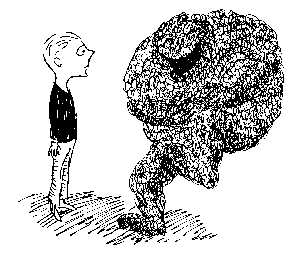
Gibberish is what happens when a person knows all the basic parts of English grammar – subjects, verbs, direct objects, prepositional phrases – but it hasn’t occurred to him that these individual parts are particularly important. One subject is as good as any other, and if we switch the subject with the object of a preposition, what difference does it really make? Of course, it makes a great deal of difference. Without careful attention, the sentence “He himself was hurrying to them, and had sent the knights before him” becomes transformed into “Himself to them horsemen he was hurrying to send before him.” The sentence is utter nonsense, and no one knows exactly how it happened. Continue reading “Against Gibberish”
David Ebenezer

Born: February 16, 2008
At: 9:53am
Weight: 8 lbs. 9 oz.
Length: 21 1/4 in.
 neumatikos